Protein Powders: A Practical Guide for Making Informed Choices
By Hawley Evilsizer
Introduction
Protein powders have gained substantial popularity and attention, particularly online. Knowing whether — and when — protein powder is appropriate for you is essential to maximizing its potential benefits.
The foundational concept to understand is that protein powders are supplements designed to help individuals meet their protein needs, not to replace whole foods. When used correctly, supplements can be beneficial and help fill necessary gaps in the diet — but they do not provide the robust nutrient package that whole foods offer.
There are several key factors to consider in evaluating the safety and efficacy of these products: the quality and source of the protein, the potential presence of heavy metals, digestibility, amino acid profile, and of course, affordability. A good place to start is learning how to read the label itself.
Look Beyond the Hype — Understanding the Label
We get bombarded with the “best” option wherever we look. When searching for a protein powder, you may encounter an array of marketing claims printed on the front of the package and throughout the product’s advertising. Learning how to read past the noise starts with understanding what the label is actually required to tell you.
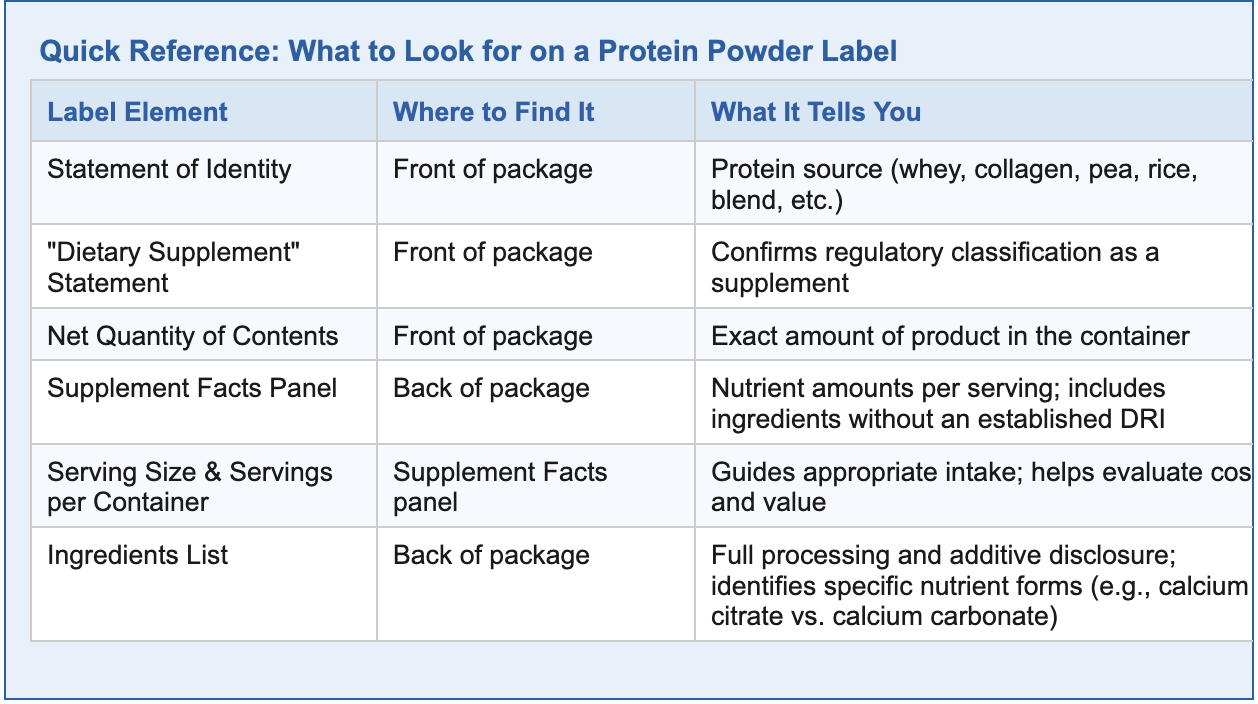
Statement of identity is required on the label and is where you will find the protein source — animal-derived proteins such as whey or collagen, plant-derived proteins such as pea or rice, or a blend. Because most protein powders are classified as dietary supplements, the label must also include the statement “dietary supplement.”
Net quantity of contents is required on the front of the package, providing transparency about the exact amount of product in the container — important both for understanding what you’re getting and for evaluating the product’s overall value.
On the back of the container, you will typically find a Supplement Facts panel, which functions similarly to the Nutrition Facts panel found on foods, with a few key differences. Notably, any dietary ingredient without an established Dietary Reference Intake (DRI) must be listed here — a requirement that does not apply to food labels.
Within the Supplement Facts panel, the serving size and servings per container are required disclosures. A serving size might be listed as 1 scoop (25g), which is essential to know both for determining appropriate intake and for accurately comparing the cost across products.
Finally, the ingredients list identifies every substance used in processing or added to enhance the product, including inactive ingredients and chemical forms of nutrients. This distinction matters because the Supplement Facts panel identifies the nutrient while the ingredient list identifies the more specific form of the nutrient. For example, calcium carbonate or calcium citrate must appear in the ingredients list, while calcium alone appears in the Supplement Facts panel. That specificity can be meaningful, for example, the form of a nutrient often influences its bioavailability in the body.
Safety and Purity
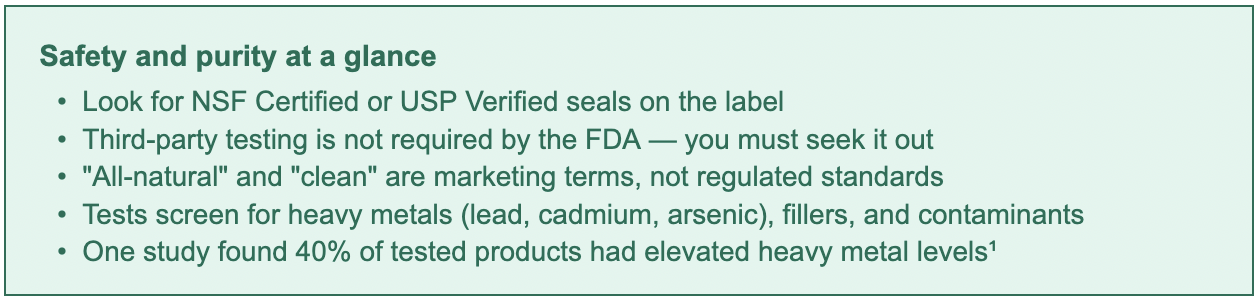
You may notice certifications on the label such as "NSF Certified" or "USP Verified." These confirm that a manufacturer recruited an independent, unbiased laboratory to test the product and verify that it meets established safety standards. This matters because dietary supplements are not subject to the same regulatory oversight as food — making third-party testing one of the most reliable ways to confirm that what the label claims is actually reflected in the product.
Key areas these tests evaluate include the presence of heavy metals, fillers, and contaminants. While marketing terms like “all-natural” or “clean” may sound reassuring, they are not legally defined or regulated by the FDA and do not necessarily indicate a higher-quality product. Third-party testing is prudent for ensuring ingredient accuracy, purity, and potency — but it is not required by law. Looking beyond the front label and evaluating actual ingredients and testing standards can help you make a more informed choice.
Make Sure You Choose a High-Quality Protein
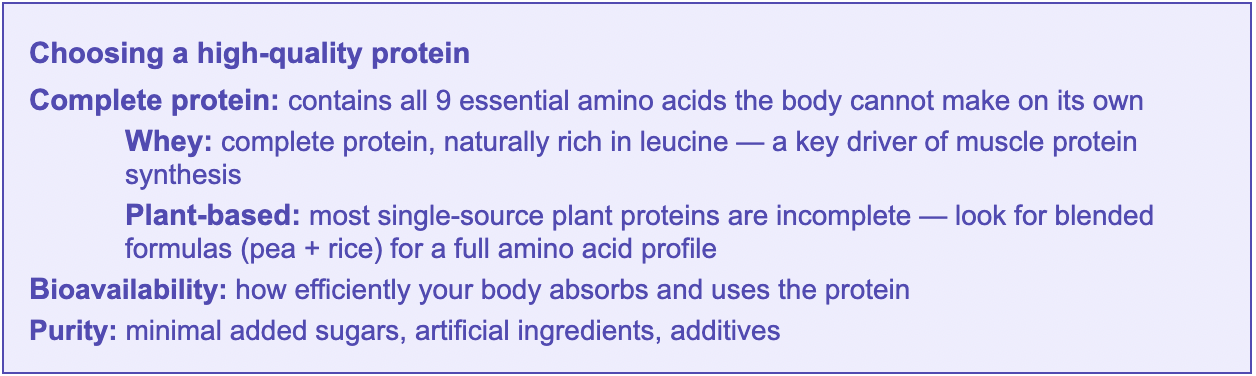
A high-quality protein powder depends on the protein source, amino acid profile, bioavailability, and purity. One of the most important characteristics to evaluate is whether the product provides a complete protein — meaning it contains all nine essential amino acids the body cannot produce on its own and must obtain through food. These amino acids serve as the building blocks of protein and are necessary for muscle repair and growth, immune function, and many other physiological processes.
Whey protein, for example, is a complete protein and is naturally rich in essential amino acids, including leucine — which plays a particularly important role in stimulating muscle protein synthesis, the process by which the body builds and repairs muscle tissue.
Plant-based protein powders can also be excellent options, though most single-source plant proteins are not complete on their own. Many manufacturers address this by combining sources — such as pea and rice protein — to create a full amino acid profile. When evaluating plant-based products, look for blended formulas to ensure complete amino acid coverage.
Bioavailability refers to how efficiently the body digests and absorbs amino acids from a protein source. Animal-based proteins, such as whey, generally have higher digestibility and bioavailability than most individual plant proteins, although well-formulated plant protein blends can still provide adequate nutrition (CITE).
Purity is another important consideration when choosing a protein powder. High-quality products contain minimal added sugars, artificial ingredients, and unnecessary additives while providing a high percentage of protein per serving.
Heavy Metals
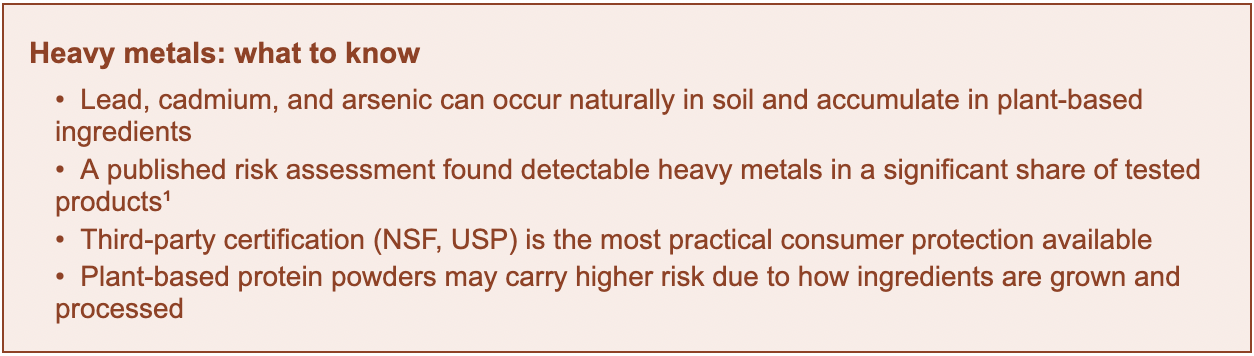
Some protein powders may contain trace amounts of heavy metals such as lead, cadmium, or arsenic. These can occur naturally in soil and tend to be more common in plant-based protein sources due to how ingredients are grown and processed. A human health risk assessment analyzing heavy metal ingestion among protein powder consumers found that a significant proportion of products tested contained detectable levels of heavy metals, raising concern for individuals who consume these products regularly.¹ Looking for a verified third-party testing certification on the label is one of the most practical steps consumers can take to reduce this risk.
Price vs. Value
The least expensive option is not always the best value — and the most expensive is not always the highest quality. Rather than focusing solely on price, consider the factors discussed above to determine the true value of a product.
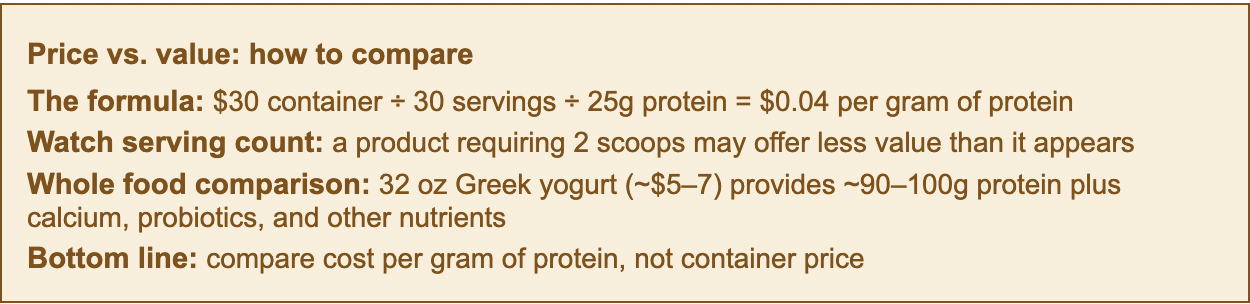
Start by examining the serving size and the amount of protein provided per serving. Some products deliver 25 grams of protein per scoop, while others require two scoops to provide a comparable amount. If a product requires twice the powder for the same protein yield, its effective value may be lower than the price tag suggests.
A useful approach is to calculate the cost per serving and the cost per gram of protein. For example, if a container costs $30, contains 30 servings, and provides 25 grams of protein per serving, the cost is approximately $1.00 per serving, or $0.04 per gram of protein ($1.00 ÷ 25g = $0.04/g). Comparing products this way offers a much more meaningful assessment of value than comparing container prices alone.
It is also worth noting that whole food sources can offer greater value — both financially and nutritionally. Foods like Greek yogurt, eggs, milk, fish, poultry, lean meats, beans, and lentils provide protein alongside vitamins, minerals, healthy fats, and fiber. For example, a 32-ounce container of plain Greek yogurt may cost around $5–7 and provide approximately 90–100 grams of protein, along with calcium and probiotics — resulting in a cost per gram of protein that is comparable to or lower than many protein powders, with significantly more nutritional breadth.
How Much Protein Do I Need at One Time?
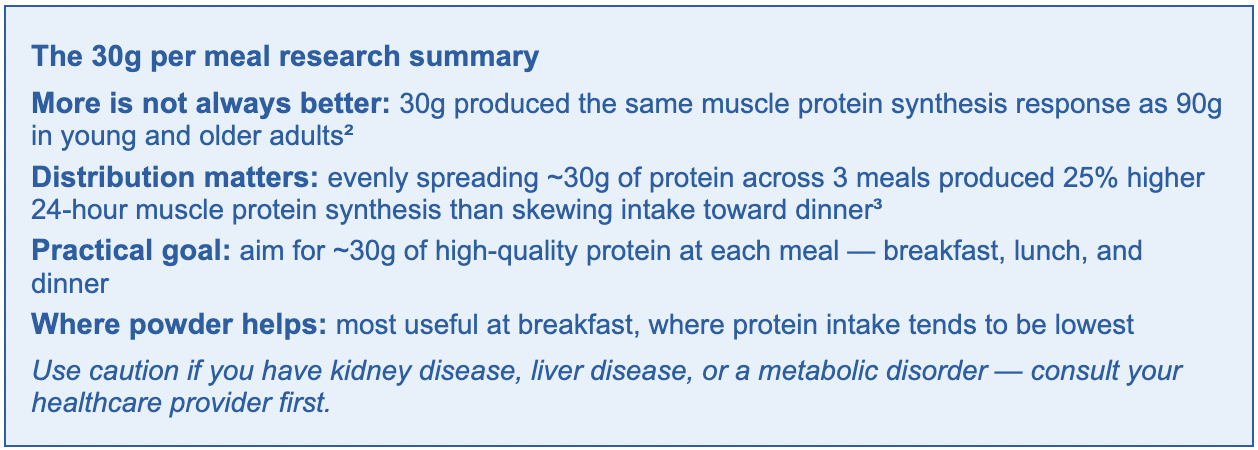
A common assumption is that consuming more protein at once leads to better results — but research suggests otherwise. A landmark study by Symons, Sheffield-Moore, Wolfe, and Paddon-Jones found that a moderate serving of 30 grams of high-quality protein was just as effective at stimulating muscle protein synthesis as a much larger 90-gram serving, in both young and elderly adults. In other words, tripling the amount of protein did not triple the benefit — the body simply reaches a point of maximal efficiency, and additional protein beyond that threshold does not continue to drive muscle building at the same rate.²
This has an important practical implication: rather than loading up on protein at one meal, the research points to how protein is distributed throughout the day as a key factor. A study by Mamerow and colleagues found that evenly distributing approximately 30 grams of protein across three meals resulted in a 25% higher 24-hour muscle protein synthesis rate compared to the more typical pattern of eating very little protein at breakfast, a moderate amount at lunch, and a large amount at dinner.³ The total daily protein intake was the same in both groups — only the distribution differed.
The takeaway is straightforward: aim for roughly 30 grams of high-quality protein at each meal rather than skewing intake heavily toward one sitting. For context, 30 grams of protein might look like a 4-ounce serving of lean beef, a cup of Greek yogurt with an egg, or a protein powder serving paired with milk. This is where a protein supplement, when needed, can play a practical role — helping individuals reach that per-meal threshold, particularly at breakfast, where protein intake tends to be lowest.
It is also worth noting that certain individuals — including those with kidney disease, liver disease, or specific metabolic disorders — should consult a healthcare provider before significantly increasing protein intake. For most people, however, protein powders are best viewed as a supplement to a balanced diet, not a replacement for it.
References
¹ Bandara SB, Towle KM, Monnot AD. A human health risk assessment of heavy metal ingestion among consumers of protein powder supplements. Toxicology Reports. 2020;7:1255–1262. doi: 10.1016/j.toxrep.2020.08.001
² Symons TB, Sheffield-Moore M, Wolfe RR, Paddon-Jones D. A moderate serving of high-quality protein maximally stimulates skeletal muscle protein synthesis in young and elderly subjects. Journal of the American Dietetic Association. 2009;109(9):1582–1586. doi: 10.1016/j.jada.2009.06.369
³ Mamerow MM, Mettler JA, English KL, Casperson SL, Arentson-Lantz E, Sheffield-Moore M, Layman DK, Paddon-Jones D. Dietary protein distribution positively influences 24-h muscle protein synthesis in healthy adults. Journal of Nutrition. 2014;144(6):876–880. doi: 10.3945/jn.113.185280